I'm moving on from Blogger and Bookish Bent. It's been a lovely time, but I need to expand a bit. So, with the help of some really wonderful, patient people, I've created a new space all my own. A professional website, if you will, but also a place to blog about more than just books - though books will still be a large focus.
It's been months of work. And I've been nervous to show it off, holding off these last few weeks because I'm so nervous. But, you don't get anywhere by being scared.
There are still some kinks to work out. We're still playing with the design of the homepage. But, I want to blog again, so it's time.
www.amandagates.com
Thanks to all who have read my posts and thoughts here. I hope you follow me and we can keep the conversations going.
Thursday, June 16, 2011
Thursday, June 2, 2011
Why, hello!
Yes, it's been awhile. Nearly two months! But, life happened in those two months and I had to take care of and recover from (actually, still recovering from) a major family situation.
But also, I've been working on something kind of cool. I'm not quite ready to share it yet, but soon. And then I'll get back on track.
I've still been reading though, and can't wait to discuss:
Half Baked
Bossypants
Hotel on the Corner of Bitter & Sweet
The Happiest Mom
Out Stealing Horses
Soon!
But also, I've been working on something kind of cool. I'm not quite ready to share it yet, but soon. And then I'll get back on track.
I've still been reading though, and can't wait to discuss:
Half Baked
Bossypants
Hotel on the Corner of Bitter & Sweet
The Happiest Mom
Out Stealing Horses
Soon!
Monday, April 4, 2011
Cutting For Stone
 This tome took me six weeks to finish, hence the lack of posts lately. I heard a bit about Cutting for Stone on Goodreads, and it has nearly five stars on Amazon with some crazy-like 900 reviews. So, lots of people liked this book. Marion, one half of twins, tells his story of childhood and coming of age in Ethiopia. He lives at a hospital where his adoptive parents, both Indian, take up residence. We learn about his birth, his growing up, the patients at the hospital, Ethiopian politics, the history of his immediate family... there's a lot in this book. I didn't quite know what I was getting into, so all of the backstory at the beginning left me wondering where the book was going. But, when I talked to my girlfriend about the book (she had also read it), she said it reminded her of Middlesex - a family history. Then it clicked for me. (I may have been slower to catch on because I was reading it on my Kindle and didn't have a book flap to sum things up for me.)
Cutting for Stone is quite deep and detailed. The author can really paint a picture, and he especially can flesh out characters. I fell in love with Hema, Marion's adoptive mother, who is a spit fire of a lady, a smart gynecologist and a mama with a sweet heart. I also fell in love with her husband Ghosh. He was a gentle man and the two had a loving relationship.
Because he's a doctor, too, the author went quite into detail when it came to the medical side of the story. I learned way more than I needed to know about lady parts, vasectomies and a whole other slew of surgeries. It was quite graphic (I felt really queasy on the bus during one part), and I would say if that turns you off, it almost takes away from the story. Almost. But, if you can keep reading through it - or skim over those parts like I did - the story gets awesomely moving in the last third of the book. This was by far my favorite part, probably because the story comes full circle, and I was sad to see the book end.
Beautifully written, somewhat graphic, and a lovely telling of a family and a culture that you don't come across every day. I'm really glad I read it.
Monday, March 7, 2011
I may not go to the movies, but I do have Netflix
 Remember when I saw nine movies in less than 4 months? In the theater, no less? Wow. Times. Have. Changed. However, with a husband that works nights every so often, a baby in bed and a Netflix account, I’ve been able to watch a few more movies lately, which, I have to say, has been great.
Whip It: Roller Girls have always intrigued me. For some reason, I think I could be good at a sport like this. Plus, it’s a hard-hitting, fast-paced sport For Girls. Which is awesome. The movie was cute. Ellen Page was her typical self. The storyline was sweet. And while I’m not a huge fan of hers on SNL, Kristen Wiig really impressed me in this movie. She was thoughtful, engaging and one of my favorite characters. I’d recommend it for a girls’ night movie, because these ladies kick ass.
The Social Network: My husband and I watched this together and we really liked it. I wasn’t too concerned since I’ve loved all things Aaron Sorkin since Sports Night (which was so before its time and canceled way too early). It was really interesting to watch an empire being created from the ground up. Eisenberg made Zuckerberg seem like an incredible douche and villain - with the touch of a (broken) heart - but yet, you still pulled for him. This was also one of my first exposures to Andrew Garfield, and I really liked him as an actor. JT wasn’t so bad either. We enjoyed discussing after the movie who really deserved part of the fortune, and who got away with a lot of money for doing so very little.
The Kids Are All Right: I liked this movie, too. It’s nothing flashy or groundbreaking, really, just nice. It was nice to watch a movie about two women raising a family where the fact that they were lesbians (or the fact that the kids had two moms) was not an issue. It just told it like it is. Marriage is hard. Motherhood is hard. People screw up, and then you still love them. Why Julianne Moore wasn’t nominated, though, is beyond me. She was terrific.
Catfish: I first heard about this documentary on Ellen (must’ve been a sick day or something), when she had the filmmakers on and just raved about the movie and the “twist.” It studies and documents the relationship of 24-year-old Nev with a family he meets on Facebook. And things aren’t as they seem. So, I knew there was a twist going in – and you can kind of assume what the twist is – yet the movie still really surprised me. There are rumors it may all be a hoax, but whatever. It was crazy. And good.
What have you seen lately?
Sunday, February 27, 2011
Physics of the Impossible: A Scientific Exploration Into the World of Phasers, Force Fields, Teleportation, and Time Travel
 Editor's Note: Like most anyone, I'm not interested in every genre of books. But, I'd love my blog to offer insights on a wide range of books. So, enter guest bloggers. Below, my husband, who is smarter and more eloquent than me, offers a thoughtful post on a book he just read. I'm a dunce at all things science so I would never pick this book up on my own, but now I think it sounds extremely interesting.
 An unfortunate and depressing fact about mankind living on planet Earth is that eventually the rock we call home will not be here anymore. The Sun will die, expanding to the point that Earth will be swallowed whole by the very star that gives us life. Of course this is billions of years from now, but what if mankind (or whatever we’ve evolved into) could escape this by traveling to a parallel universe? What if mankind could escape the solar system long before this happens by traveling to another star, perhaps faster than the speed of light? These are the topics brought to life by theoretical physics professor Michio Kaku of the Graduate Center of the City University of New York in his book Physics of the Impossible.
I’m sure right now you’re thinking, "Why would I want to read 300 pages about theoretical physics?" I have an engineering and physics background in my former career, and that doesn’t even sound fun to me. However, at some point we’ve all thought about what it would be like to time travel. We’ve all seen teleportation in Star Trek, or traveling faster than the speed of light in Star Wars. How many movies and TV shows have been made about robots becoming smarter than we are and turning on us? Terminator or I, Robot, anyone? What about Watson on Jeopardy?
Kaku takes the pop-culture sci-fi topics that everyone has thought about at one point or another, and describes the physics that may actually make them possible in a (more or less) easy-to-read fashion. You don’t need to have a huge science background to understand what’s going on. Kaku deconstructs into three classes what most people think are impossibilities. The first class being impossibilities that don’t break known laws of physics, and may be possible in this or the next century, including force fields, teleportation, invisibility, robots, UFO’s, and starships. Can you imagine how the world would change if you could order a book on Amazon and it would be teleported to you? You think that the USPS has a hard time now?! Also discussed are class II impossibilities that might be realized within a millennia or more (time travel, parallel universes) and class III impossibilities which violate the known laws of physics which would require a fundamental shift in mankind’s understanding of physics (perpetual motion machines).
Kaku takes great care in honoring the past scientific discoveries by giving a bit of history from the scientists whose research has brought us to where we are today. Sadly, many of these great thinkers were persecuted for their beliefs (some even committing suicide) that were later proven in labs. Ludwig Boltzmann was hounded for his belief of atoms and hanged himself in 1906 because of the intense pressure. What Boltzmann didn’t realize was that Einstein had written a paper in 1905 demonstrating their existence.
While the research from the past has made possible everything society takes for granted today (the internet, cell phones, computers, space travel), we are an infantile society when it comes to scientific discovery. It is highly likely that societies are thriving in the universe (or in other universes) that are much more advanced than we are. Kaku paints a broad picture of how we may discover and use technologies to become a more advanced civilization, and on the extreme long-term timescale, survive. Kaku does so in a way that someone with little scientific background but a little bit of nerd in them can understand. I myself can’t wait for his next book Physics of the Future: How Science Will Shape Human Destiny and Our Daily Lives by the Year 2100.
Wednesday, February 23, 2011
Mockingjay
 Note: As with my last post, I can't discuss this book without revealing SPOILERS. Read on at your own risk.
Well, the Hunger Games trilogy just got more disappointing with each book. I thought Mockingjay was pretty boring, and just when it would seem to be getting good, it would end up disappointing me. The districts are in rebellion and Katniss is the Mockingjay, but so much of this book is spent with her delirious, weak, confused, etc. Sure, the girl's been through a lot, but she's also stronger than this.
I hated that she wasn't leading the mission to save Peeta from the Capitol. And that she didn't try to save him ASAP. I feel like the Katniss from Book 1 would've done that.
I thought it was boring that so much of this book was about training and prepping and shooting propos.
It finally got interesting, near the end of the book, when Katniss and her group got near the Capitol and broke away from District 13's instructions and went on their own to assassinate the president. Finally, there was some fighting and Katniss got to lead like she should've been leading all along.
But, the ending sucked. Sucked. Not one part of it made me happy. I was on Team Gale from Day 1, and I think it's totally unrealistic how that relationship was (un)resolved.
I think an unnecessary person was killed. And I think the way she was killed was a lame attempt to make it seem OK that Katniss and Gale ended up the way they did. A ridiculous ploy.
I don't think Katniss ended up with the life she should've had.
My thoughts: Collins didn't want to be predictable, so she came up with ridiculous and poor attempts at keeping readers on their toes. All the things I wanted to happen, I admit, would have been predictable outcomes. However, for young adult novels, that's OK most often. Plus, I think in the name of being unpredictable, Collins made Katniss out to be weak and boring, and as a fan of our heroine from the beginning, that hurt me as a reader. I was actually angry about it.
Maybe I'm missing a deeper meaning, or I'm missing the point. But, in my opinion, the trilogy peaked with The Hunger Games. That book was great. The series as a whole? Just, eh.
Tuesday, February 15, 2011
Catching Fire
 Note: If you have not read the Hunger Games and plan to, there are mostly likely SPOILERS ahead. However, because all three books are out, and you can easily read the book flaps and other reviews, I don’t know how much of a spoiler I’m actually being. And, I can’t really talk about how I feel about this book without mentioning certain details, and I really want to hear what other fans think, too. So: SPOILERS. There. I warned you twice. :-)
-------------
Not surprisingly, I gobbled up (no pun intended) the second Hunger Games book, Catching Fire, in less than a week. Surprisingly, I’m having a hard time deciding how I feel about it. When the book opens, Katniss and Peeta are off on their victory tour through the districts. Of course, here comes their design team to dress them all up again and prepare them for the tour. While I love the design team (Cinna definitely captured my heart), I thought to myself, “I already read this in the first book.” So, right away I was disappointed. And then I wondered, “Is Collins going to drag us through each and every one of the 12 districts?” Because: Boring. But she didn’t, so she redeemed herself there.
But when we’re only a few chapters into the book and the tour is over, then what fills the rest of the pages? Oh, another Hunger Games. She can’t possibly figure out a way to throw Katniss back in to this hot mess that makes sense, can she? Oh, but she can. Granted, it was a surprise to everyone – a completely unorthodox move by the Capitol. However, I’ve already read about the Hunger Games, so again: disappointed. I felt like Collins was taking the easy way out.
Another note: As an editor, it drives me CRAZY that they spell Capitol with an “o.” It’s a city, not just a building. It should be spelled Capital. Who let that get by?
To be fair, I can see why providing us with another Games isn’t completely stupid. We get to see a different environment then the one the Capitol created in the first book. We also get to meet a whole new slew of characters - though not quite as deeply as we could’ve, I don’t think. But another Games? Eh.
However, in the end, there was a scheme to it all. There was a reason, and I have to say it’s a good reason. So, again, Collins redeemed herself. In my opinion, if you cut out some unnecessary sections—and the few “review” pages up front of each book (just assume we read the previous book(s) and move on!)—this series could have been two books instead of three. Though, how many two-book series are there in the world? I’m guessing not too many.
So. I’ll say I liked it. It offers up good characters, it’s easy to read, it’s engaging, and I love Katniss. And maybe after finishing Mockingjay, I’ll like the series as a whole better than each individual part? To be continued...
Tuesday, February 8, 2011
The Book Thief
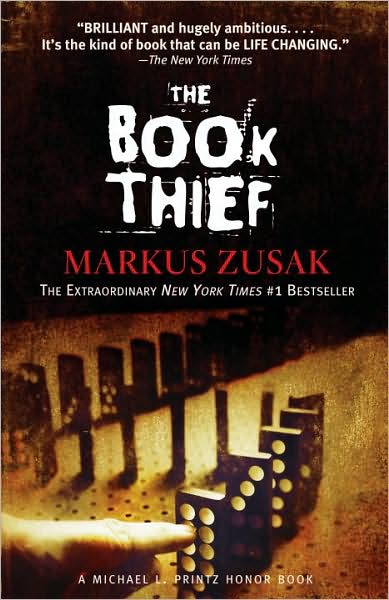 The Book Thief is a haunting, yet wonderful book. It’s actually considered a young adult novel in many places, though it seems much more of a mature and complicated story than I would’ve enjoyed in my young-adult days. It takes a little while to get used to the narration and the structure of the book. The book is narrated by Death, and at first, I wasn’t sure it would work for me. Plus, Death has these bolded, starred outbursts (that my bff cleverly compared to the bubbles in Pop-Up videos) within his story, which causes a bit of disruption while reading. But after several pages, I got used to it and actually grew quite fond of Death as a narrator.
The story follows Liesel, a young girl growing up in a foster home in Nazi Germany. The Hubermann’s have taken her in when it was clear to her own mother that their family was in danger. Death comes across Liesel’s path in a couple of instances in her lifetime and is struck by this special girl, which is why he chose to tell her story.
A few themes I loved:
Death’s compassion. It hit me about halfway through the book that Death, at least The Book Thief’s Death, isn’t scary. He’s sad. He’s busy. He’s compassionate. He’s devastated about sitting up top bath houses and catching body after Jewish body that’s been gassed and killed. He can’t believe the things humans do to one another. He talks frankly about when he takes people and when he doesn’t. I learned to love Death as a character.
In the back of the book, there’s a Q & A with the author, Markus Zusak, and he says this about Death as a character: “Death was to be exhausted from his eternal existence and his job. He was to be afraid of humans – because after all, he was there to see the obliteration we’ve perpetrated on each other throughout the ages – and he would now be telling this story to prove to himself that humans are actually worth it.”
Hans & Rosa Hubermanns love. When we first meet this couple, they poke at each other, gripe at each other, call each other names. You think, 'Wow, this couple must loathe one another.' But it’s exactly the opposite. They are so much in love. When your husband brings home a Jew to hide in your basement and you ask no questions because you would do anything for him… Well, that’s love. And they loved Liesel like their own. It’s almost heartbreaking.
A favorite quote: “Life had altered in the wildest possible way, but it was imperative that they act as if nothing at all had happened. Imagine smiling after a slap in the face. Then think of doing that 24 hours a day. That was the business of hiding a Jew.”
The other side of the story. When we think of Nazi Germany, it’s so easy to hate all the people who lived there. How could they let this happen? How could they just stand by? Sure, we know the stories of people like the Hubermanns who were brave and helped those who need it. But, some just choose survival. They might not agree with the Nazi party, but they join, just to survive. They might not want to go fight for them, but they do so their son doesn’t have to. There is always another side. And it makes you wonder: Who would I be in that situation? Would I risk my butt? Or would I fly under the radar? Either way works, just as long as you live, right? And the same goes for current times. I try to remember to always give someone the benefit of the doubt. Because people can be going through some tough stuff and just need a break.
I loved this story. It was engaging and special and it sticks with you once you close it. It’s not joyous by any means, but there are several happy parts to it. Happiness to hang on to amongst the rubble.
I seem to enjoy books about WWII. A few other posts: The Zookeeper's Wife; City of Thieves; The Guernsey Literary and Potato Peel Pie Society; Those Who Save Us; and Sarah's Key.
Thursday, January 27, 2011
My Kindle: First Thoughts
The Hunger Games was my first Kindle purchase. It was $5. I clicked “buy” on Amazon and within 30 seconds, the book was on my Kindle. I have to say, that’s pretty amazing. The Kindle pages look very similar to book pages, and turning the page took just a press of the forward arrow.
As I started reading on my Kindle, this is how I felt for about the first half of the book: I missed that feeling of accomplishment. With a real book, you get that satisfaction as the pages you’ve read start outnumbering the pages you haven’t. You can physically see how far you are. You can also easily flutter through to see how many pages you are away from the end of a chapter. With a Kindle, sure you can page to the end of a chapter, but it’s not as easy as holding your finger in the book to mark your spot. Along the bottom of a Kindle page, it shows the percentage of what you’ve read. So, this should give me that feeling of accomplishment… but as a visual learner, this meant very little to me. But, I assume as I read more and more books this way, I’ll get use to this method.
But, I have to say, by the last half of the book, I forgot I was reading on my Kindle. I got used to the “flipping,” it read easily on the e-ink, and it was so convenient to slip into my purse. (Maybe I would’ve stuck with Pillars of the Earth if I had it on a Kindle instead of lugging around 1,000 pages? Probably not.) I’m reading a real book again at the moment, and love holding it in my hands, but I have to say, the Kindle isn’t so bad to hold either.
Another downfall: I’ve told one of my bffs that she’ll really enjoy The Hunger Games. And I realized I can’t lend it to her. And that makes me sad. But, I have a goal to declutter even more in 2011, which means selling lots more of my books. The reason I keep books is to lend them out. But, having more space and a more peaceful mind needs to outweigh keeping books just for the possibility of lending them (sorry, please still be my friends!), and maybe more Kindle books is the way to do that.
Commenting on my first Kindle post, Manda asked me if using a Kindle means I still feel “connected” to everything. Manda said she likes picking up a book and turning off all that technology. I didn’t feel that way at all. My Kindle isn’t connected to anything. I’m not planning to sign up for news through it or anything. Nothing bongs or tweets at me while I’m reading. It’s going to strictly be for books and just because it’s “electronic,” well, even after just one book, it doesn’t feel “electronic” to me. I’m just reading as I always have.
Other people commented on missing libraries and bookstores. First, I’ll never stop perusing bookstores. I love them, even when I don’t buy anything, which is most often. However, I’ve been buying (or having people buy for me) a majority of my books online for years now. They’re cheaper. They come right to your house. It’s easy for gift-giving. So, that part I won’t miss, actually. I can still stop at B&N over lunch – and buy children’s books now! – and the only thing that really changes about my buying habits is that my books get delivered to the Kindle in seconds as opposed to the house in days by mail.
In the end, I really like it. I do still feel a touch guilty about that, though. And, like iTunes, when you can just click “buy” and instantly have a book in place, it’s important to learn restraint. Because I still have plenty of books on my shelf left to read, too, I’ve put a limit on my Kindle purchases. Right now, nothing more than $5 or so - and with $40 in gift cards to spend, that's a lot of books. After awhile, I’ll re-evaluate. And I’ll obviously still be reading both ways. I don’t expect ever to give up actual books, but if it comes cheaper on the Kindle and it’s something I really want to read, the Kindle it is.
So, now what do you think? I think I've struck a good balance, plus I tried, and enjoyed, something new. Have I changed any minds?
Friday, January 21, 2011
The Hunger Games
 Kind of like Twilight, I really didn't know what The Hunger Games trilogy was until I read in my Entertainment Weekly about the movie being made about the books. Then the third book was listed on several Best Of 2010 lists, so I thought maybe I'd give it a try. The first book was $5 on Kindle, and I needed to try that out, too (more on my first Kindle experience in another post), so I decided The Hunger Games would be my first Kindle book.
Synopsis:
In the ruins of a place once known as North America lies the nation of Panem, a shining Capitol surrounded by twelve outlying districts. The Capitol is harsh and cruel and keeps the districts in line by forcing them all to send one boy and one girl between the ages of twelve and eighteen to participate in the annual Hunger Games, a fight to the death on live TV. Sixteen-year-old Katniss Everdeen, who lives alone with her mother and younger sister, regards it as a death sentence when she is forced to represent her district in the Games. But Katniss has been close to dead before - and survival.When I first read the synopsis, I wasn't sure. Seemed a little too Sci-Fi for me... however, I've enjoyed Sci-Fi a bit more lately, plus this was a young-adult novel, so I knew it wasn't going to get too complicated or out there for my liking. The premise is obviously depressing and I couldn't imagine actually enjoying a book that kills off teenagers one by one - for sport. But the author does a decent job of making several of Katniss' competitors, and the residents of the Capitol, unlikable while at the same time making our heroine our primary concern.
The Hunger Games are kind of like the Olympics because there's training, an opening ceremonies, costumes, interviews and performance. A good portion of the book is devoted to all these elements leading up to the actual Games. While it was interesting and you meet some important characters during this part of the book, I was anxious for the action to start. And, I have to say that while reading about kids killing each other (sick, right?) was hard, the Games were the most interesting, fast-moving part of the novel. You learn about strategy, survival, greed, alliances, trust and love.
When you go into book knowing there are sequels, you lose part of the mystery, but then The Hunger Games ends on a loose end and definitely makes you want more. I really liked the book, it was written very well and was very engaging. I read for two hours straight last Saturday night and I haven't done that in a long, long time. So, I'm very excited for the next two books.
Tuesday, January 11, 2011
The Immortal Life of Henrietta Lacks
 Henrietta Lacks was a thirty-something black woman living in the 1940s when she died of cervical cancer. The way the cancer ravaged her body, doctors knew there was something special about those cancer cells. They took a sample, and long story short, those cells never died. All cells eventually die, but not Henrietta's. They went on to become HeLa cells and helped scientists do many, many things, like cure polio, discover the many strains of HPV, perform cloning, discover drugs for leukemia and influenza... it goes on and on. Because these cells never died and continued to reproduce at an alarming rate, they gave scientists a set of base cells to always pull from and experiment on. Today billions of HeLa cells can be found in labs around the world.
 However, Henrietta and her family were never aware these cells had been taken from her and then passed around the world. It took decades before articles about HeLa cells even got her name correct (they used Helen Lane and others) that it came as quite a shock to her children and husband (again, decades later) that her cells were still alive. This raised major issue because here was a poor family with many health problems among them and there seemed to be unfairness that while their mother's cells were helping science and making money, they couldn't afford health care.
Author Rebecca Skloot was a ambitious and determined 20-something (and white) woman when she decided to write this book. It took her a long time to just get permission from the family to talk to them. They had been through the ringer and stepped on enough by people with other motivations - they weren't willing to talk to another reporter. She endured hang ups. Abandoned meetings. Complete ignoring. Once they decided to let her in, they let her in very, very slowly and it took several more years to get all the information about Henrietta and her family and her cells that Skloot would need to write this book.
The book follows Skloot on her journey to write the book, while also alternating between chapters of Henrietta's history, Lacks family history and the science behind the HeLa cells. I thought the layout was well done. I liked learning about Skloot's struggles and fears. She also wrote about the science portion in a very digestible manner. Cell division and its experiments are not easy to understand, but she made it easy. And while they were hard to get to know at first, you grow a fondness for the Lacks family, particularly Henrietta's daughter Deborah. She was Skloot's main ally - though she had many fears and doubts and even some paranoia (how Skloot kept up her patience, I'll never know). Deborah was so young when her mother died, she just wanted to learn more about her.
The book brings up so many ethical issues. There are no laws on the books that say patients have a right to the tissue samples that doctors take (with or without their knowledge), even if those tissue samples go on to make millions. While it seems very unfair that the Lacks family received nothing from Henrietta's cells, if they were to sue, they would most likely come up empty.
Is this fair? I can't really wrap my head around it. One expert Skloot talked to said that it's our moral duty as humans to provide parts of ourselves for research to help the greater good. That makes sense. If the Lacks family were asked way back then about using Henrietta's cells for science and said no, where would we be? Or, if they got permission to stop usage of HeLa cells now, science would take huge steps back. But, then you go back to the fact that they can't afford many, many things you'd want them to be able to afford. Is there a middle ground? Probably not without opening a huge can of worms.
Reading about Skloot's journey, but also Deborah and her family's journey of acceptance for what has happened, is so interesting. They're insanely proud and also pissed at the same time. And I think I would be too. Deborah said, "If you're gonna go into history, you can't do it with a hate attitude. You got to remember, times was different."
Skloot meets another relative of Henrietta's who believes, along with many family members, that Henrietta is alive as an angel - as the cells. She's doing God's work as the cells, helping people all over the world. I loved this sentiment.
The book is well written, easy to follow and wholly entertaining. It's a great and very impressive effort by a first-time author. I highly recommend it. It gets you thinking.
Thursday, January 6, 2011
Quick thoughts on Huck Finn, Stieg Larsson & Best books of 2010
There have been several bits of book news lately that I’ve wanted to comment on. I had dreams of separate posts for them all, but that’s not going to happen, so I’m smashing them all into one post instead.
1. Huckleberry Finn Censoring.
This came as quite a shock to me when I heard it on the news the other day. It seems very strange and misguided to change the text of a historic book in order to protect innocent readers, increase use in schools or just be more politically correct. Like Dr. Sarah Churchill says in a Guardian article,
“The fault lies with the teaching, not the book. You can't say 'I'll change Dickens so it is compatible with my teaching method'. Twain's books are not just literary documents but historical documents, and that word is totemic because it encodes all of the violence of slavery. The point of the book is that Huckleberry Finn starts out racist in a racist society, and stops being racist and leaves that society. These changes mean the book ceases to show the moral development of his character.”
However, an EW blogger points on that this censorship would only happen in certain copies of the book – most likely those meant for school-aged children. So, is this any different than censoring R-rated movies on TV so an immature audience doesn’t see/read something its not ready for? I thought that was an interesting point, at least. [Edited to add: This post by Flavorwire, changing other challenged books to be more "appropriate" is great. Also, Susan Orlean's take in the New Yorker.]
In the end, I think I fall on the side not changing the book. It just seems wrong. If I wrote a book one day, I would hate for the powers that be to decide to change it after I’m gone. (Yes, this is a short and simple thought on an very complex issue. But, I don't have the energy to really get into it right now.)
2. New Yorker’s Millennium Trilogy column.
Critic Joan Acocella asks Why Do People Love Stieg Larsson’s novels? She points out many reasons not to like them. Bad dialogue. Loose ends. Unnecessary detail. Not enough detail. A poor choice in male protagonist. I read other bloggers commenting on Acocella’s column saying they agreed with her – they hate the books, too. However, I don’t think Acocella hates these books. She does defend Larsson and the books a bit as well. She thinks the claims he’s a women-hater because of the scenes of violence against women are unwarranted. She likes Lisbeth as the heroine. And, she praises the books use of technology.
I agreed with her on all accounts. Sure, the books have too much detail – I barely kept reading Dragon Tattoo because the first 100 pages were so hard to get through – and there were huge loose ends (Lisbeth's sister??) and bad dialogue. I chalk the loose ends up to the author’s early death. And bad dialogue? Well, see Star Wars and Twilight, and I still love those. I too loved Lisbeth as a heroine, and I was very impressed by Larsson’s knowledge of computers and hacking. He was very up-to-date - if not ahead of our time considering when he wrote these - on security measures and hacking abilities when it comes to technology.
Something I found interesting was Acocella's analysis of Larsson’s view of Sweden. Perhaps it isn’t the Utopia of everything that we Americans think it is?
3. With the New Year came several Best Of lists. Here are just a few:
Goodreads Choice Awards
New York Times
Time Magazine Fiction & Nonfiction
I was pleased to see The Immortal Life of Henrietta Lacks on several lists. I’ve had this book for several months and am reading it right now, so I feel proud to have picked this one out on my own before seeing it make all these lists.
The third book in the Hunger Games series, Mockingjay, also made many lists. I’m late to the game on this series – much like Twilight – but I’ve heard good things, so I plan to start it soon.
Room is also all over these lists. I’ve read about this book and heard from trusted sources that it’s pretty amazing, yet quite sad and disturbing. I’m not quite sure it’s up my alley, at least for the moment.
The Emperor of All Maladies also made several lists. This has been on my Amazon Wish List for awhile. I’m waiting for this book to either drop its Kindle price or come out on paperback, but I’m definitely interested.
I didn’t read The Corrections, so Freedom, even though it made ALL lists, isn’t high on my own reading list.
I couldn’t believe Time picked Faithful Place as a top book of the year. While I liked it, it wasn’t as good as her others, and with only picking 10 books out of all from 2010, I couldn’t believe this was one of its choices.
What are your thoughts? Censorship opinions? Millennium lovers or haters? Your top books published in 2010?
Monday, December 27, 2010
Juliet, Naked; Or Breaking Up with Nick Hornby
Oh Nick, I think it’s time we part ways. I really, really do. We’ve had some amazing times - High Fidelity, About a Boy, Fever Pitch – and during those times, I never thought this day would come. But Nick, you’ve disappointed me too many times in a row now. And I’m puzzled. What happened? What happened to the great “maleness” you gave your characters – those funny, self-deprecating, quirky yet redeeming men that graced the pages of my favorites of yours? Sure, we all evolve and I understand you had to try something new, like speaking from a female voice (How to be Good) or the voice of a child (Slam), but when those things didn’t work for you (and honestly, they so didn’t work for you), why didn’t you go back to what did?
I talked you up, man. I would rave about you. I wrote papers in college analyzing your complex characters. Those first books are ones I keep on my shelves – they’ve moved with me from dorm room to first apartment to condo to townhouse. They've never been thought of as bait for Half-Priced Books. That’s how much they mean to me. Yet, with each following book you’ve written, part of my love for you dies. Your stories aren’t funny anymore. They’re actually either puzzling or quite boring, in fact. And why should I continue to love someone who bores me?
This last book, Juliet, Naked, was the nail in the coffin, I’m afraid. I did finish it, for the most part because it was quick and something to do on the bus, but I was never attached to any of the characters. Not the jerk/creepy music fanatic, not the lonely middle-aged woman, not the washed up, lazy rock star. Nothing stuck with me, and really I didn’t see the point in the story at all. And that lackluster ending? If I had liked the book, it would’ve been a complete disappointment. But then, its lackluster-ness might have just been on par with the rest of the story. If so, you get props for consistency, I suppose.
So, Nick, I’ve been disappointed one too many times. I’m going to have to say goodbye. I’m too busy to waste my time on you anymore. I would say: it’s not you, it’s me. But that would be a lie. It’s you.
Monday, December 20, 2010
I Got a Kindle. Am I Sellout?
 For the past month, the hubby has been talking to me about the Kindle. “Don’t you think you’d like one of those?” Books are cheaper, it’s easier to carry, yadda yadda yadda. I always said no. I like my books. I like seeing the covers. I like turning the pages. Mostly, I like the community of sharing books with friends like Willikat and CMS and my mom and mother-in-law. Plus, as a devoted reader (and a magazine editor), I want to support the publishing industry as much as I possibly can.
[Note: However, when my hubby, the music lover, couldn’t quite get on board with iTunes right away and kept purchasing CDs to show his support, I was on him about all the space they take up (!) and how much easier and cheaper iTunes was. Same argument, different genre. A tad hypocritical?]
Well, I got a Kindle for my birthday. It was a very generous gift from my MIL; she was super excited to buy it for me, and even though Jon told her I didn’t want one, when she asked a second time, he told her to go for it. I was very surprised by the gift. As we were on the way to our birthday dinner, Jon asked me if I really liked it. I told him I thought it was cool, it’s convenient, the books are cheaper…but it will take me awhile not to feel like a sellout. The publishing industry is my world; am I betraying it by reading books like this? Even my boss, who does everything via iPad, has yet to purchase a real electronic book.
However, it is very easy to read on. I don’t have books on there yet, but I’ve been reading the user’s manual and the e-paper is pretty cool. Plus, the books are like 50 percent cheaper, which in tough economic times, that means a lot. And, as a friend pointed out, I don’t have to read all books this way.
I’m going to keep it, because it was a lovely gift from someone who cares about me a lot. And I don’t remember the last time I received (or treated myself to) something this extravagant. (I use the free cell phone from our plan and a hand-me-down iPod; I don’t have my own computer.) And it’s not like I won’t use it. I’ll just use it while having an internal struggle and a bit of book-lover's guilt. All the while still reading physical books, too, and sharing those with my friends.
So, am I a sellout? I’ll keep you posted on my thoughts on the Kindle.
Wednesday, December 15, 2010
Best Books I Read in 2010
Well, 2010 was much slower in the reading department for me, which kind of sucks when you have a book blog that you like to keep up with. But, for three months out of the year I didn’t pick up one book, let alone a magazine. Newborns tend to have that affect on you. I had no idea what was going on in the world. Things still pop up in random conversations and I’m like, “What? When did that happen?” Oh, it happened in April, May or June… That’s why I don’t remember. And then, after you become a parent, things like reading on a snowstormy Saturday goes out the window too. I remember when I read Deathly Hallows and Breaking Dawn over 24-hour periods the weekends they came out. Yeah, never doing that again, until perhaps age 50. Anyway, when the only time I have to read is on the bus and the occasional lunch hour, it’s slow going. However, each December I’ve compiled a roundup of my favorite books of the year, so here it goes:
The Help. One of my first books of 2010 and I’m so glad I read it. This book was touching, educational, funny, sad, joyful, vengeful and moving all at once. I fell in love with Skeeter and Aibileen, and I grew more and more embarrassed of our past. I laughed, I cried. Two things that always guarantee I’ll like and remember a book. I’m very interested in the movie, too.
Millennium Trilogy. Yep, I was one of the millions who got sucked into Lisbeth Salander’s three-book adventure. While the books could be quite detail-driven and it was easy to get lost in side stories that were overwhelmed with information and Swedish-sounding surnames, there was enough action and female kick-ass-ery in these books to keep me flipping the pages. Plus, being a journalist, I very much enjoyed the evolution of Millennium magazine. They were tough, conscious-driven editors – we don’t have enough of those these days. But, in the end it was all about Lisbeth and she’s definitely a character for the ages.
Where Men Win Glory. Once again Krakauer taught me a bunch of things I didn’t know. He did it with Under the Banner of Heaven and Into Thin Air and once again with this book. I learned so much more about the wars we’re fighting, basic training, friendly fire, the (despicable) marketing of war, and a man who was truly unique. Pat Tillman was a thoughtful, generous, caring person whose life ended much too early. The book made me mad and sad and depressed about our current situation, but it also made me a bit hopeful that perhaps there are more men like Pat Tillman out there. God knows we need them.
So, what were your favorite books you read in 2010?
Archives:
End of the Year, 2009
A Look Back 2008
Top Books 2007
Subscribe to:
Posts (Atom)